
Call Now (403) 366-3770
How much attic insulation does an Alberta home need? Learn how to check your current insulation and what R-50 and R-60 mean in inches.


You've heard that your attic should have R-50 or R-60 insulation, but how do you know what's already up there? Maybe you've owned your home for years and never looked inside the attic. Or you've opened the hatch, seen a thick layer of insulation, and wondered whether it's enough.
It's a common question, especially in older Alberta homes where insulation may have been installed decades ago. The good news is that you can often get a preliminary idea of your insulation level with a flashlight, a ruler, and a few minutes of your time.
R-value measures how well insulation resists the movement of heat. The higher the number, the greater its thermal resistance.
An attic with R-50 insulation offers considerably more resistance to heat transfer than one with R-20. During an Alberta winter, that helps keep indoor warmth from escaping through the ceiling. In summer, insulation also slows heat moving from a hot attic into the rooms below.
Both numbers have a place in Alberta's building code, which helps explain why homeowners hear different recommendations.
Under Section 9.36 of the National Building Code, 2023 Alberta Edition, the prescriptive requirements for ceilings below attics in Climate Zone 7A depend partly on the home's ventilation system.
Calgary falls within this climate zone, although requirements can differ elsewhere in Alberta.
These figures describe the effective thermal resistance of the ceiling assembly, which accounts for more than the insulation material alone. Having a heat-recovery ventilator also doesn't automatically qualify a home for the lower figure. The equipment and installation must meet the applicable code requirements.
These are prescriptive requirements used for code compliance. Other approved compliance methods are available, and existing homes aren't automatically required to be upgraded whenever building standards change.
You don't need specialized equipment to make an initial assessment. A flashlight, ruler or measuring tape, and your phone are enough to get started.
Choose a time when the attic isn't excessively hot or cold, and use a stable ladder to reach the access hatch. Complete your inspection from the opening or a properly supported walkway, without stepping onto ceiling drywall or disturbing unfamiliar insulation.
Open the hatch and shine your flashlight across the attic. Look at how evenly the insulation covers the ceiling and whether some areas appear thinner than others.
If you can see the tops of ceiling joists across large sections, the insulation may be relatively shallow. Also look for material that's been moved aside, flattened, or disturbed during previous work.
If you can safely reach the insulation from the access opening, hold your ruler vertically and measure from the ceiling surface beneath the insulation to the top of the material.
Avoid compressing the insulation while measuring, since that can give you an inaccurate reading. For example, you might find approximately eight inches of loose-fill insulation. Write that number down, along with anything you know about the material.
Insulation depth can vary across an attic. Ideally, you'd compare a spot near the access hatch, an area toward the centre, and another area farther away.
Only take measurements where you can safely reach. Photographs can help you compare areas that are farther away, and anything that requires moving through an unsafe area can be left for a professional.
Photograph the ruler beside the insulation and take wider pictures showing the coverage across the attic. These can help you remember what you've seen and give an insulation contractor a starting point for discussing the attic.
A safety note: Older attics may contain vermiculite insulation, which can contain asbestos. If you see unfamiliar loose, pebble-like material, leave it undisturbed and arrange professional advice. The same applies if you notice exposed wiring, wet insulation, or unsafe access conditions.
Once you've measured the depth, the next question is what that measurement tells you.
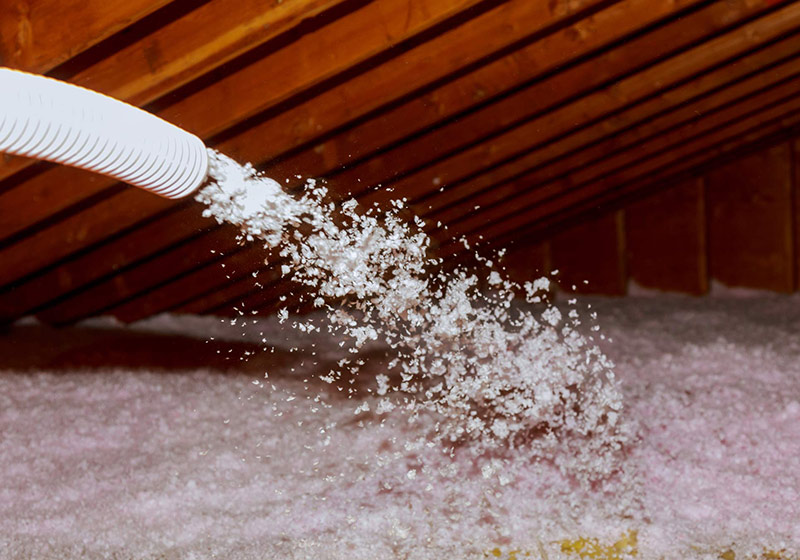
Different insulation materials provide different amounts of thermal resistance per inch. Blown fibreglass and blown cellulose are common attic materials, but their performance varies by product and installation density.
The following table gives approximate depths based on the R-value ranges published by Natural Resources Canada.
These are general estimates. The manufacturer's specifications, installed density, and settled depth determine how much insulation a particular product requires.
For example, 10 inches of insulation doesn't automatically mean R-30. Depending on the material, it could provide more or less thermal resistance. If your attic contains multiple insulation layers, their individual R-values may also need to be considered.
Let's say you've checked your attic and found one of three common situations.
The insulation looks shallow throughout. If there's only six or eight inches of older loose-fill material, a substantial top-up may be worth investigating. Depending on the material and its condition, your attic could be well below current insulation targets.
The insulation is deep but uneven. You may have plenty of material near the hatch and much less around the edges or areas where previous work was completed. Those thin spots can allow additional heat transfer, even when the average depth looks reasonable.
The insulation is deep and consistent. If you have a substantial, even layer of insulation, further investigation can help determine its actual R-value and whether adding more would be worthwhile.
Adding insulation is often straightforward when the existing material is dry, clean, and in good condition. However, a few other conditions should be checked before covering it with another layer.
Small openings around plumbing stacks, electrical penetrations, bathroom fan housings, and attic hatches can allow warm indoor air to escape into the attic. These gaps should be addressed before adding insulation so the new material can perform effectively.
An attic needs clear airflow through its intended ventilation system. Insulation that blocks soffit openings can interfere with that airflow, so baffles and intake pathways should be checked during an upgrade.
Attic frost, damp insulation, water stains, or signs of mould deserve investigation before additional material is installed. These concerns are particularly relevant during Alberta's cold winters and sudden temperature changes, when moisture problems can develop around the roof and attic.
If your attic already has a consistent R-50 level and the surrounding system is performing well, going to R-60 may provide a smaller improvement than you'd expect.
Insulation delivers diminishing returns as R-value increases. The additional layer still reduces heat transfer, but the benefit is less dramatic than upgrading an attic with significantly inadequate insulation.
For example, increasing insulation from R-20 to R-50 substantially improves resistance to heat flow through that layer. Moving from R-50 to R-60 provides a smaller additional improvement.
The cost of the work, condition of the existing material, air sealing, and how long you plan to remain in the home are all worth considering. If your attic is already well insulated, addressing gaps, uneven coverage, or other performance concerns may offer a better return than simply adding more depth.
Epic Roofing & Exteriors helps homeowners across Calgary, Red Deer, and surrounding communities assess attic insulation, ventilation, and related performance concerns.
If you've measured your insulation and aren't sure what the numbers mean, we can inspect the attic, identify the existing material, check its condition, and explain whether a top-up makes sense. That gives you a clear recommendation based on what your home needs.
Contact Epic Roofing & Exteriors for a detailed attic assessment and free quote.

Epic Roofing & Exteriors - Residential & Commercial Services


