
Call Now (403) 366-3770
Compare rubber roofing and asphalt shingles for Calgary homes. Learn about cost, hail resistance, lifespan, maintenance, insurance, and long-term value.


Replacing a roof in Calgary often begins with a practical question: should you install another asphalt shingle roof, or is it worth paying more for a rubber roofing system?
Asphalt shingles remain the familiar choice for most homeowners. They are widely available, offered in many colours and performance levels, and usually cost less upfront. Rubber roofing tends to attract attention after a major hailstorm, repeated repairs, or when a homeowner wants a longer-term solution with stronger impact resistance.
Both materials can work well in Alberta. The better option depends on how long you plan to stay in the home, the condition and design of your roof, the appearance you prefer, and how much you are comfortable investing now to reduce the possibility of future replacement costs.
In this article, rubber roofing refers to synthetic shingles designed for sloped residential roofs, such as products manufactured from recycled rubber or TPO (thermoplastic polyolefin). It does not refer to the EPDM membrane commonly used on flat and low-slope commercial roofs.
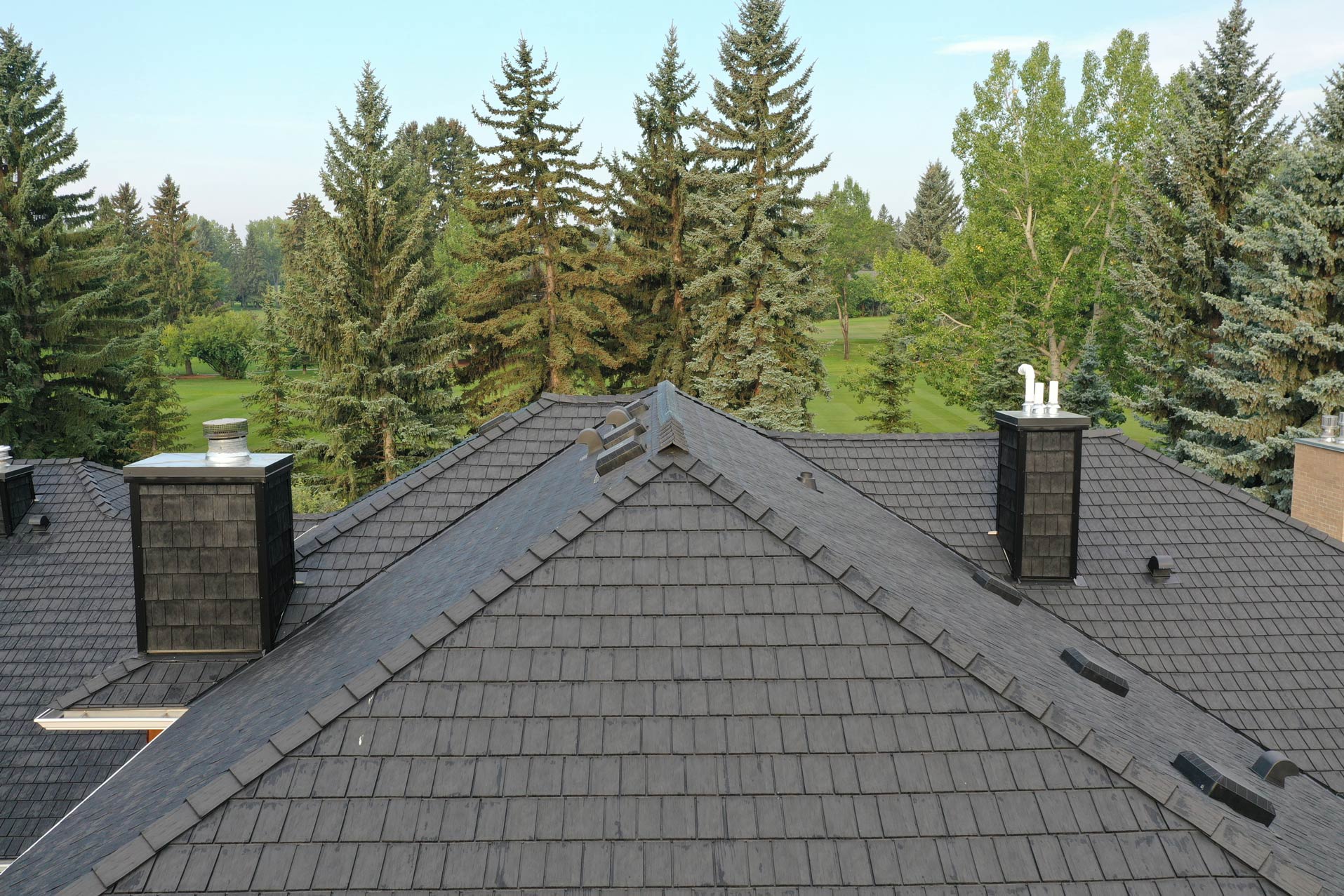
Rubber shingles are manufactured in interlocking panels or tiles that can resemble natural slate or hand-split wood shakes. Their flexible construction helps them absorb impact and remain stable through wind, freezing temperatures, summer heat, and repeated weather changes.
For Calgary homeowners, impact resistance is usually the main attraction. Many rubber roofing products carry a Class 4 rating under the UL 2218 impact test, which is the highest classification in that test. The rating does not mean the roof is immune to severe hail, but it does indicate stronger tested resistance than many standard roofing products.
Asphalt shingles remain one of the most common residential roofing materials in Calgary because they combine affordability, broad availability, and a wide range of colours and profiles.
Architectural shingles are thicker and more dimensional than basic three-tab shingles, while premium lines may include enhanced wind resistance, stronger warranties, and Class 4 impact ratings. This means the decision is not always between durable rubber and basic asphalt. Homeowners can also choose a higher-performing asphalt system that provides additional storm resistance without moving to a full synthetic roof.
The quality of an asphalt roof depends on more than the shingle itself. Underlayment, flashing, ventilation, fastening, roof-deck condition, and installation practices all affect how the system handles Calgary weather and how long it lasts.
These are general differences, not guarantees. The exact product, roof design, installation quality, warranty, and maintenance history will affect the performance of either system.
Calgary roofs face a demanding combination of hail, high winds, snow, summer UV exposure, rapid temperature swings, and repeated freeze-thaw cycles. A suitable roofing material must perform through all of these conditions rather than excelling in only one area.
Rubber roofing is often considered after a homeowner has already replaced or repaired an asphalt roof following hail damage. Its flexible composition is designed to absorb impact without cracking as readily as more brittle materials, which can make the higher initial cost easier to justify for someone concerned about repeated storms.
Premium Class 4 asphalt shingles can also provide strong impact resistance and may offer a useful middle ground. A homeowner who wants better hail performance but needs to reserve part of the renovation budget for siding, eavestroughs, or other considerations may find that a Class 4 asphalt system provides a more balanced solution.
Neither option can protect every exterior component during a severe storm. Hail can still damage vents, flashing, skylights, eavestroughs, windows, siding, and other parts of the home even when the shingles perform well.
Rubber roofing systems are designed to remain flexible through repeated temperature changes. Their panel construction can also provide strong wind performance when the product is fastened and detailed correctly.
Asphalt shingles also perform well in Alberta when they are installed according to the manufacturer’s requirements. Problems are more likely when the shingles are older, poorly sealed, incorrectly fastened, or already weakened by previous storms.
In both cases, the complete roofing system matters as much as the visible material. Proper underlayment, ventilation, flashing, fastening, and roof-edge protection all contribute to long-term performance.
Rubber roofing normally has a higher installed cost because it is a premium material and requires more specialized installation. Asphalt shingles are offered at a wider range of price points, making them easier to fit into many roof replacement budgets.
The final cost of either system depends on roof size, slope, access, tear-off, disposal, underlayment, flashing, ventilation, and any repairs needed to the roof deck. Comparing only the price of the visible shingles can therefore give an incomplete picture.
For a homeowner planning to remain in the house for 15 or 20 years, the higher upfront price of rubber roofing may be easier to justify if the goal is to reduce the likelihood of another full replacement. Someone who expects to sell within a few years may receive better value from a quality asphalt system, particularly if the premium paid for rubber roofing is unlikely to be fully recovered in the sale price.
When reviewing quotes, compare the complete scope of work, product specifications, workmanship coverage, and manufacturer warranty rather than focusing only on the total at the bottom of the estimate.
Rubber roofing is often selected for its longer expected service life and relatively low maintenance requirements. While relatively newer to the market, some warranties for rubber shingles are for 50 years. It should still be inspected after major hail or wind events, particularly around vents, flashing, roof edges, valleys, and other penetrations.
Repairs can be more specialized because the contractor needs to understand the specific panel system, and replacement pieces must match the installed profile and colour. Before choosing a synthetic roof, it is worth asking who can service the system locally and how replacement materials will be sourced in the future.
Asphalt shingles are familiar to most roofing contractors, and isolated repairs are usually more straightforward. Materials are widely available, although matching an older roof can become difficult after years of fading or when a product line has been discontinued.
The service life of an asphalt roof varies considerably (15-30 years typically). Product quality, attic ventilation, installation, sun exposure, storm history, and maintenance all affect how quickly the shingles age.
Rubber roofing appeals to some homeowners because many products contain a high percentage of recycled material. A longer service life may also reduce how often the roof needs to be removed and replaced.
Asphalt shingles are petroleum-based, but removal does not always mean they must go directly to the landfill. Epic Roofing & Exteriors participates in asphalt shingle recycling through its Razphalt initiative, which repurposes recovered shingles into paving and surfacing material.
The environmental comparison is therefore more balanced than it may first appear. Rubber roofing can offer substantial recycled content and longer replacement cycles, while responsible asphalt recycling can reduce the waste created during a conventional roof replacement.
Some insurers offer discounts or other policy benefits for Class 4 impact-resistant roofing, although eligibility varies by insurer, policy, location, and product.
A Class 4 rubber roof may qualify, and a Class 4 asphalt shingle may qualify as well. Before choosing a material based on possible savings, contact your insurer and ask:
The contractor should be able to provide an itemized invoice, product information, installation date, and warranty documents after the project is complete. Whenever possible, get the insurer’s answer in writing before selecting the roofing material.
Rubber roofing may make sense when you have dealt with repeated hail damage, expect to stay in the property for many years, and want a slate or shake-style appearance without using natural slate or cedar. It may also appeal to homeowners who are comfortable making a larger initial investment in exchange for stronger impact resistance and a longer expected service life.
Asphalt shingles may be more practical when the initial budget is the main concern, you expect to sell within a shorter period, or funds also need to cover siding, eavestroughs, insulation, or roof-deck repairs. The wide range of standard, architectural, premium, and Class 4 products also allows the roofing system to be matched more closely to the available budget.
The right decision should follow an inspection of the existing roof and a discussion about ownership plans, storm concerns, appearance, warranty expectations, and total project cost. A material that provides good value on one home may not make the same financial sense on another.
Epic Roofing & Exteriors has helped Alberta homeowners protect their homes since 2001, completing more than 40,000 roofing and exterior projects across Calgary, Red Deer, and surrounding communities.
Our team installs both asphalt and synthetic roofing systems, which allows us to compare the options based on the home rather than recommending the same product for every project. We can explain how each system handles local weather, what is included in the quote, how the warranties differ, and where the long-term costs may appear.
Epic Roofing & Exteriors is the only Owens Corning Platinum Preferred Contractor in Southern Alberta and offers a Lifetime Workmanship Warranty on qualifying roofing projects.
Contact Epic Roofing & Exteriors for a free, detailed quote if you are comparing rubber roofing and asphalt shingles.

Epic Roofing & Exteriors - Residential & Commercial Services

